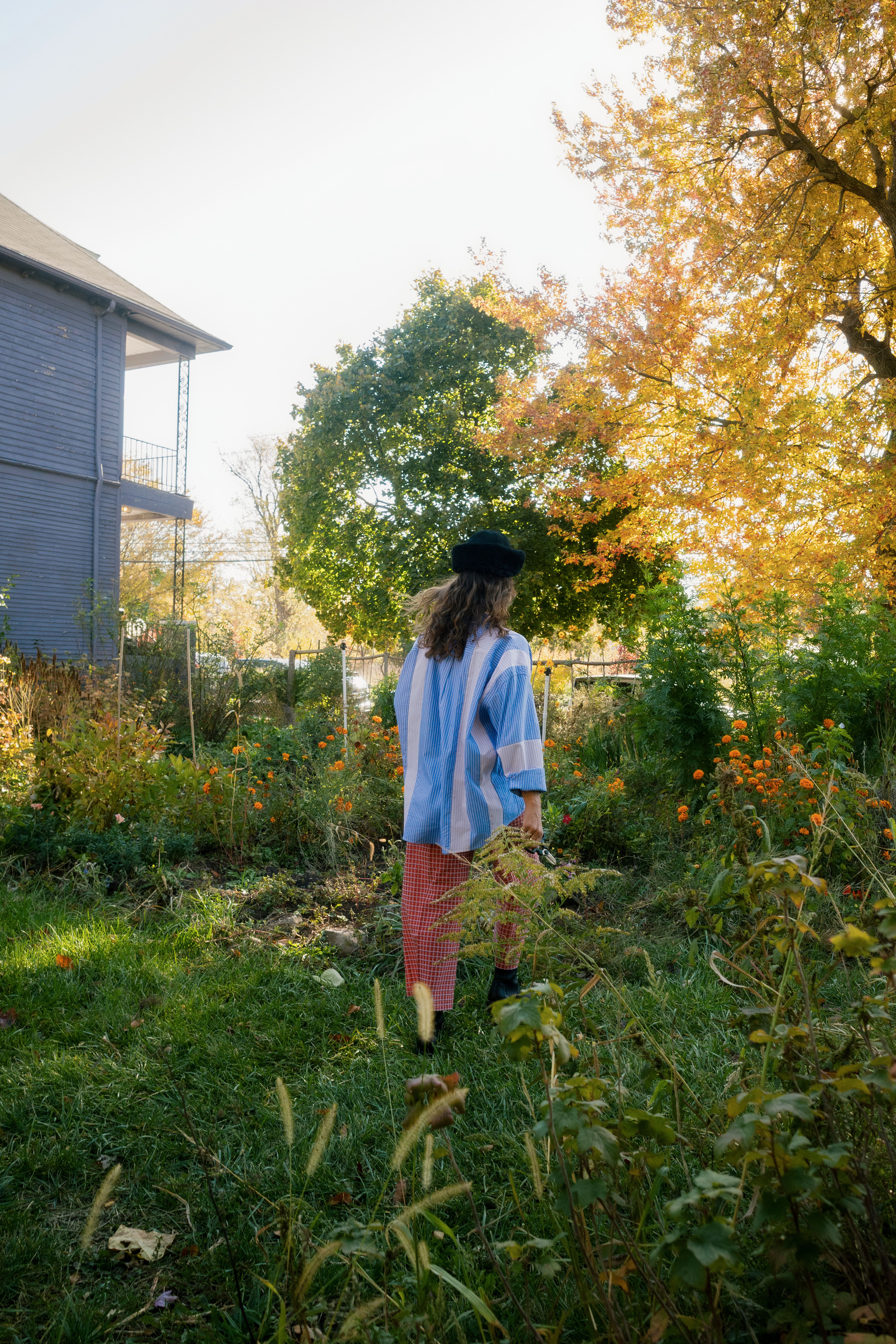

Rooted in the soil of Detroit, Bree Hietala’s floral practice unfolds through acts of care, attention, and reverence for the fleeting. As the co-founder of Ghost Acre, an urban farm she began with her husband in 2013, Bree’s relationship to flowers is inseparable from place, time, and community. What began as a commitment to food justice has since blossomed into Mother of Pearl, a floral design studio shaped by shared labor and the slow rhythms of the land.
Sourcing exclusively from their own farm and a close network of regional growers, Mother of Pearl’s arrangements resist the globalized floral industry in favor of something more intimate and responsive. Each composition captures a moment in time as buds break open, petals unfurl, and foliage turns, embracing impermanence as a form of beauty rather than something to be resisted. Bree’s work honors not only the bloom at its peak, but also the quiet poetry of its passing.
At the heart of Bree’s practice is adoration for the ecosystems that sustain us, for the collaborators and friends who make the work possible, and for the ever-changing seasons of life itself. As a grower, florist, and mother, she approaches flowers as companions within a broader creative ecosystem that continues to shift, soften, and expand. In this conversation, Bree reflects on building a practice rooted in relationship, designing in harmony with nature’s cycles, and finding meaning in what is temporary, tender, and deeply alive.
eugenie: You started your urban farm, Ghost Acre, with your husband in 2013. What was the inspiration behind choosing to cultivate farmland in the heart of Detroit?
Bree Hietala: My husband and I were living in NYC and getting very involved with urban farming and food justice, mostly in Brooklyn and upstate NY. We both became pretty obsessed with Detroit, which has such an inspiring urban farm network and has access to so much green space within the city. I’m also from the suburbs of Detroit, so moving back to be closer to my parents was the cherry on top.
eugenie: Ghost Acre was the seedbed, literally, for the beginnings of your flower business, Mother of Pearl, which you started with your close friend Maxine Mcrann.
Growing from just an initial small patch of plants to play with, your practice evolved into a vibrant design studio serving the floral needs of businesses across the city. What did that transition look like for you, and how has it shaped your relationship to flowers?
Bree: At the time we started Mother of Pearl, I was working at Roses Fine Foods, and Ghost Acre was supplying a bunch of vegetables for the diner. For a grower, one of the most fulfilling relationships you can have is with a chef who is talented, creative, and fully invested in local food, which is Molly Mitchell. So that was a very special moment in time.
It’s also the place I met Maxine! She was eating there, and I kept refilling her cup with hot coffee, and if you’ve met Max, you know everyone falls in love with her. We ended up sharing phone numbers and decided to start working with flowers together. After we decided on a name for the company (thanks to Candy Bar and lots of wine), our company was official. We had a lot of friends who had restaurants and bars, so we just started connecting with that network by providing weekly flowers for them that we grew. The rest was history.
eugenie: An important part of your work is the choice to source your flowers ethically and locally. Each arrangement is constructed with material from your own farm or from other farmers in the region. Why is this choice meaningful to you?
Bree: It connects us to the seasons and allows us to create designs that are hyperlocal. And on every level, it makes sense: individually, locally, and globally.
Individually, it makes our work more enjoyable because, rather than driving to the wholesaler for every event, we are walking to the farm to see what we have available. One of our “jobs” is to stay fully immersed in our local plant world to watch what they are doing (blooming flowers, changing foliage, ect), which is a very dreamy homework assignment. Locally, it’s beneficial for our pollinators, birds, and ecosystems. We don’t use chemicals for our growing practices, so the farm becomes a little haven of biodiversity. Globally, we are disrupting the system that relies on shipping flowers halfway across the world.
And, it’s best for our clients because they get flowers that can really capture a snapshot of the season. Many of our clients and brides are the best, and they have a very flexible approach to flowers. They often have a specific color direction in mind, but trust us to find the local flowers and native foliage that fit the right palette. A true joy to work like that.
eugenie: Both Ghost Acre and Mother of Pearl emerged from the collaborative space between you and a dear companion. In what ways does this pattern of relationality factor into your creative practice, professionally and personally?
Bree: Having the opportunity to work alongside your friends with all their brilliance just makes everything so much more fun and fulfilling. We work with a small group of friends: we have two head designers (Eggy and Zoey) and a larger team that does installs, plantings, and big events (Kevin, Colson, and Dave). We have all worked together for many years, and that consistency of friendship, accounts, projects, and plantings is a very lovely flow of how our business works.
As for growing flowers, we grow a lot of our own flowers, but we also rely on local growers throughout the season—special shout out to Laura + Matt at Amalgam farms, Liz at Bloomtown, Gwen at Coriander Farm, Caroline at Jaro farm, and a couple neighbors that have their own dahlia patches that we harvest from weekly in the summer-fall (thanks Eggy + April).
eugenie: The workings of a farm, or even a flowerbed, also rely on a network of relationships to truly thrive. The twisting roots, the pollinators, the hands that tend the land – these all create the structure through which life can grow and blossom. What does your own creative ecosystem look like these days as a florist and a mother?
Bree: Everything is truly connected. As a global community, I think we are starting to realize just how interconnected everything is and how our structures and systems need flexibility to accommodate growth and change (a forever constant). We have two young kids, and we are discussing school options, and I keep being drawn to the idea that the best school for kids is one rooted in nature and surrounded by gardens.
So, our ecosystem has new demands and will have new shifts so that it can keep thriving. Maybe the flower farm will become more than just a production spot and start offering space for nature-based childhood education, community events, and a free space for kids to get dirty.
eugenie: Another unique aspect of floral work is the careful, necessary negotiation with temporality. In what ways does time influence the relationship between florists and their flowers?
Bree: It’s everything. Flowers aren’t supposed to last forever—nothing does. And if it does last forever, it lacks real depth in beauty. I love when we design with sensitive flowers that last only a short time, and you start seeing the reality of their little lifespans in real-time at an event. Like, I’m thinking of poppies or orange cosmos, magical flowers that have such a quick bloom and then start drooping pretty quickly after that. I think that moment is just as beautiful as the perfect blooming moment.
I’m also very excited to grow old and see how I change and what I look like with long grey hair and pretty wrinkles. So, maybe my new fascination with the wilting after the bloom is just a very graceful embrace of aging.
eugenie: After months of tending and cultivating the land from which your material arises, the flowers are carefully arranged and appreciated by family, friends, and strangers alike. Yet, unlike many other art forms, the work you produce is deeply ephemeral by nature. The flower bursts into bloom just for a passing moment, before it disappears again.
How does the ephemeral composition of your art form influence the way you see your practice and the world at large?
Bree: As we keep honing in our design style year after year, I can now say the goal is simply to mimic nature. A full embrace of the seasons, and how plants have different uses at different times of the year.
One of my favorite plants is forsythia. We use her for different purposes throughout the year: in SPRING, she is our focal floral with big branches of yellow blooms. In SUMMER, she’s our favorite greenery for our weekly accounts because she lasts 2 weeks in a vase. In FALL, she has the most magnificent foliage that turns this deep purply maroon that we love to use for our moody fall weddings.
eugenie: The art of floral arranging is laden with poetry and metaphor, with flowers themselves embodying themes of romance, longing, and even grief across human cultures. Do you have a meaningful memory or experience involving a flower?
Bree: I lived on Mackinaw Island for a couple of years when I was little, and they have a lilac festival to celebrate when the flowers are blooming. People dress up in purple clothes, there’s a parade, and everyone rides horses around to celebrate spring and the magic of lilacs. I still (along with most Michiganders) have a deep love for lilacs. And now, I have added a few flowers to the list of obsessions: dahlias, marigolds, hydrangeas, and amaranth.
eugenie: Flowers bloom and wither in a continual cycle of growth and change, a rhythm of growth mirrored in our lives and the lives of species around us. We each go through season after season, shedding old versions of ourselves and sprouting into bright new forms, colors, and textures.
What is one piece of clothing that has stuck with you over the years, and one new piece that you have recently welcomed?
Bree: Ever since I had my first son, I have worked hard to keep a wardrobe that is high quality, small in quantity, and allows me to not have to think twice when grabbing anything. So the clothing may change, but there are fundamental elements that stick with me: thin cashmere sweaters, oversized overcoats, everything linen, thick wool sweaters, silk blouses, cotton t-shirts, good boots with small heels, tiny purses, buttery leather loafers, all the chore coats, something red.
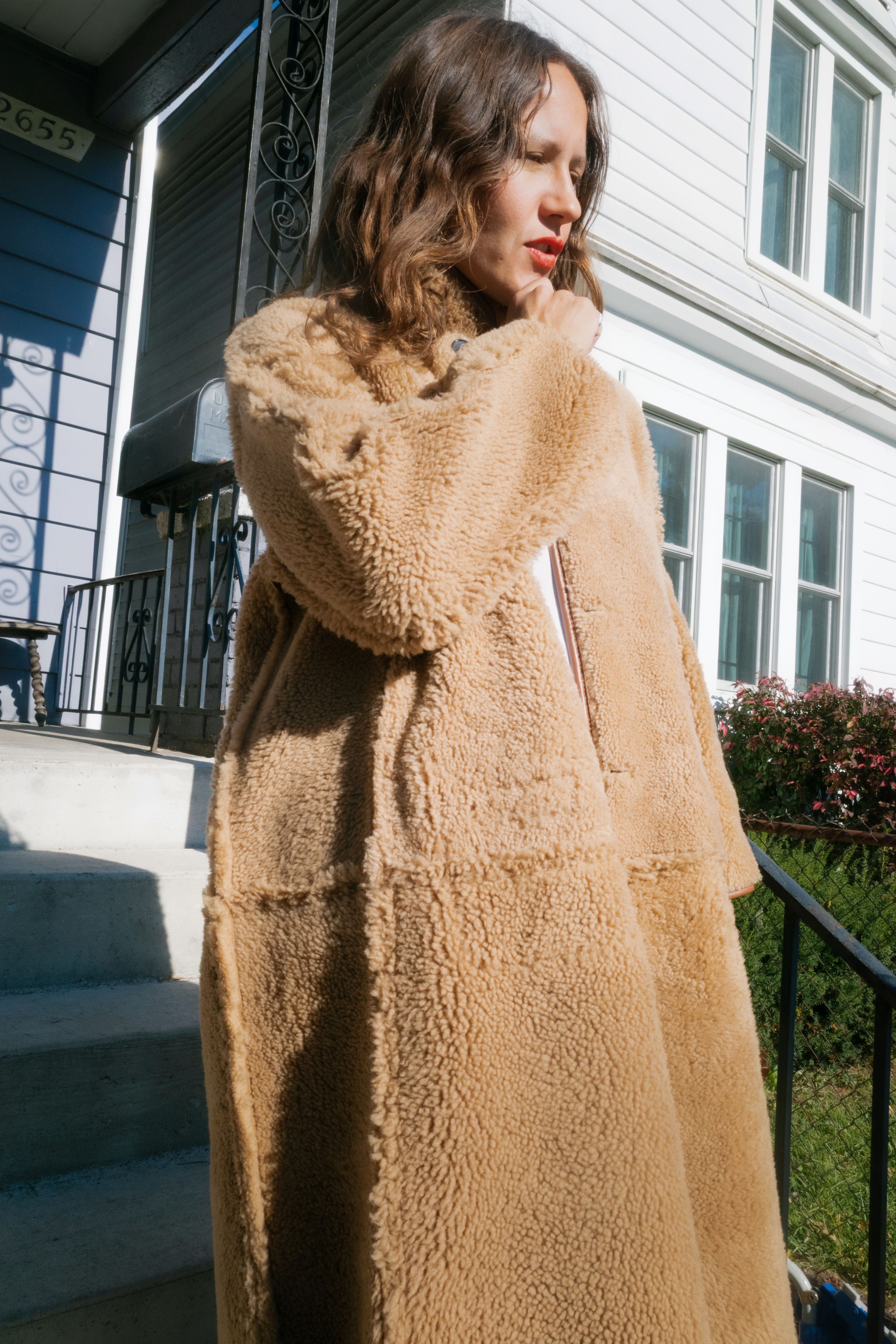

The most recent piece that I am obsessed with (and plan to wear til I’m 100) is a 7115 by Szeki duster coat that looks like what Queen Elizabeth would wear to go hiking in the woods. I wore it in the featured shoot with eugenie and fell in love. I actually was leaving for NYC the morning after the shoot and ended up racing to eugenie as soon as they opened so I could buy it for my trip. I wore it for 4 days straight, stomping around the city with two kids. It’s perfect for everything—I can wear it to walk the dogs when it’s raining, or wear it to harvest from the farm, or wear it to drink martinis.
eugenie: We’re thrilled to partner with Mother of Pearl for Valentine's Day. What other makers or pieces at our shop resonate with you?
Bree: I’m always obsessed with Lily Forbes and so grateful that you guys carry her incredible designs. Now that I’m thinking about it, I need to buy that black silk 1994 dress I wore in the shoot because I absolutely need it! Can you save that for me??
Photographer Website: Les Loups
Interviewee Website: Mother of Pearl